Tutorial
Understanding and expanding Python: hands-on experience with the Python internals
Cristián
maureira.dev
@cmaureir




The Structure
of this tutorial
- 🧑🏫 The tutorial has two parts
- 🖵 Each part will have a short presentation
- 🏃➡️ A set of exercises follows each presentation
- ⭐ Some exercises have optional follow-ups
- ⭐ If you finish quickly, continue with the next one
- ⭐ If you do everything even faster, help others!
First Part Presentation
Navigating cpython
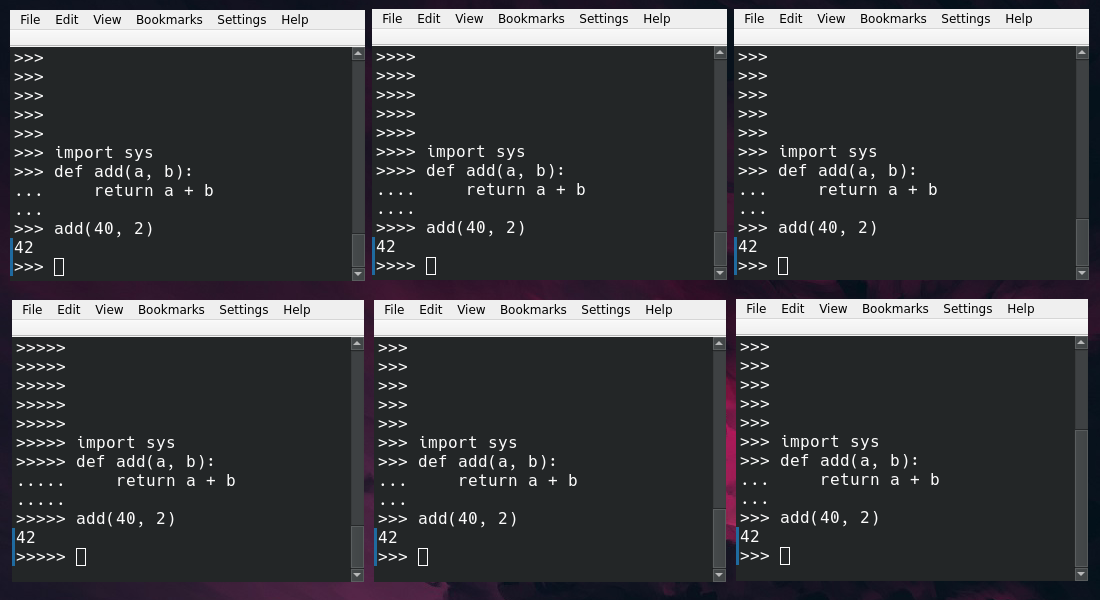
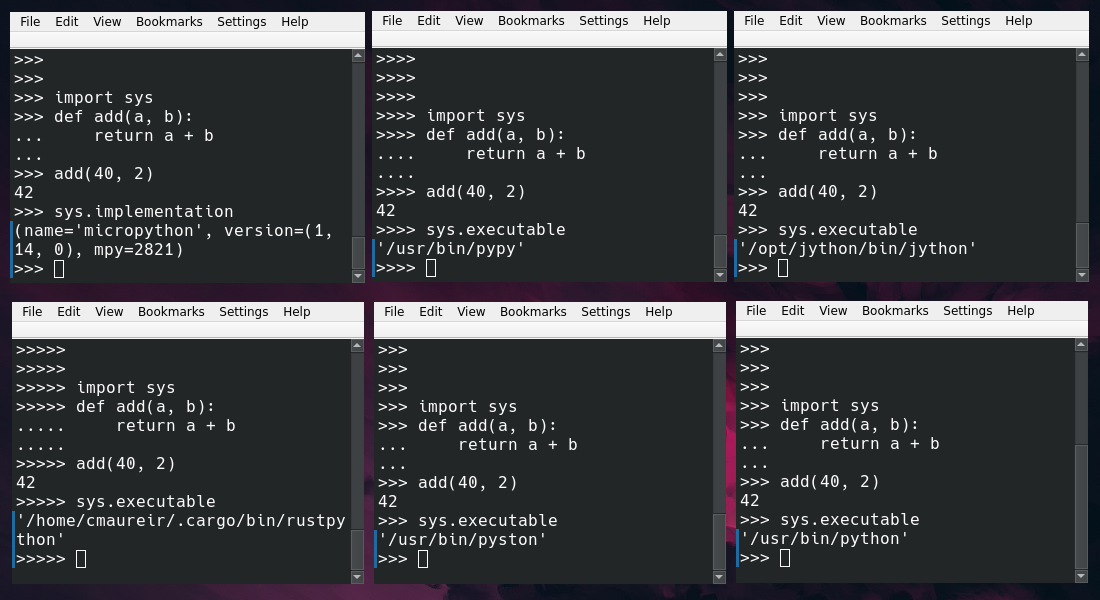







CPython is the standard implementation
To get around it
We need to understand C
a little bit
Python and C (1/3)
    # A comment
    import my_module

    def add(a: int, b: float) -> float:
        return a + b


    def main():
        msg: str = "Hello World"
        x: int = 3
        y: float = 0.14
        z: float = add(x, y)
        print("%f" % z)

    if __name__ == "__main__":
        main()
    // A comment
    #include <my_module.h>

    float add(int a, float b) {
        return a + b;
    }

    int main(){
        char msg[] = "Hello World";
        int x = 3;
        float y = 0.14;
        float z = add(x, y);
        printf("%f", z);

        return 0;
    }
Python and C (2/3)
    l = [1, 2, 3, 4, 5]

    l2 = []

    l2.append(42)
    l2.append(17)
    l2.append("Hallo")
    int a[] = {1, 2, 3, 4, 5};

    int *a2 = malloc(3 * sizeof(int));

    a2[0] = 42;
    a2[1] = 17;
    a2[2] = "Hallo"; // BOOM! 🔥
    // Don't forget to free
    // the memory you allocated
    free(a2);
Python and C (3/3)
    typedef struct {
      size_t size;
      int *data;
    } int_vector;

    int *create_vector(size_t n) {
        return malloc(n * sizeof(int));
    }

    void resize_vector(int_vector *v, size_t n) {
      v->size = n + 1;
      v->data = realloc(v->data, v->size * sizeof(int));
    }

    void set_vector(int_vector *v, size_t n, int x) {
      if(v) {
        if(n >= v->size) {
          resize_vector(v, n);
        }
        v->data[n] = x;
      }
    }
    // Yay, we got "kind of" a vector
    int_vector *v = create_vector(10);
    set_vector(v, 0, 123);
- We might need to reinvent the wheel
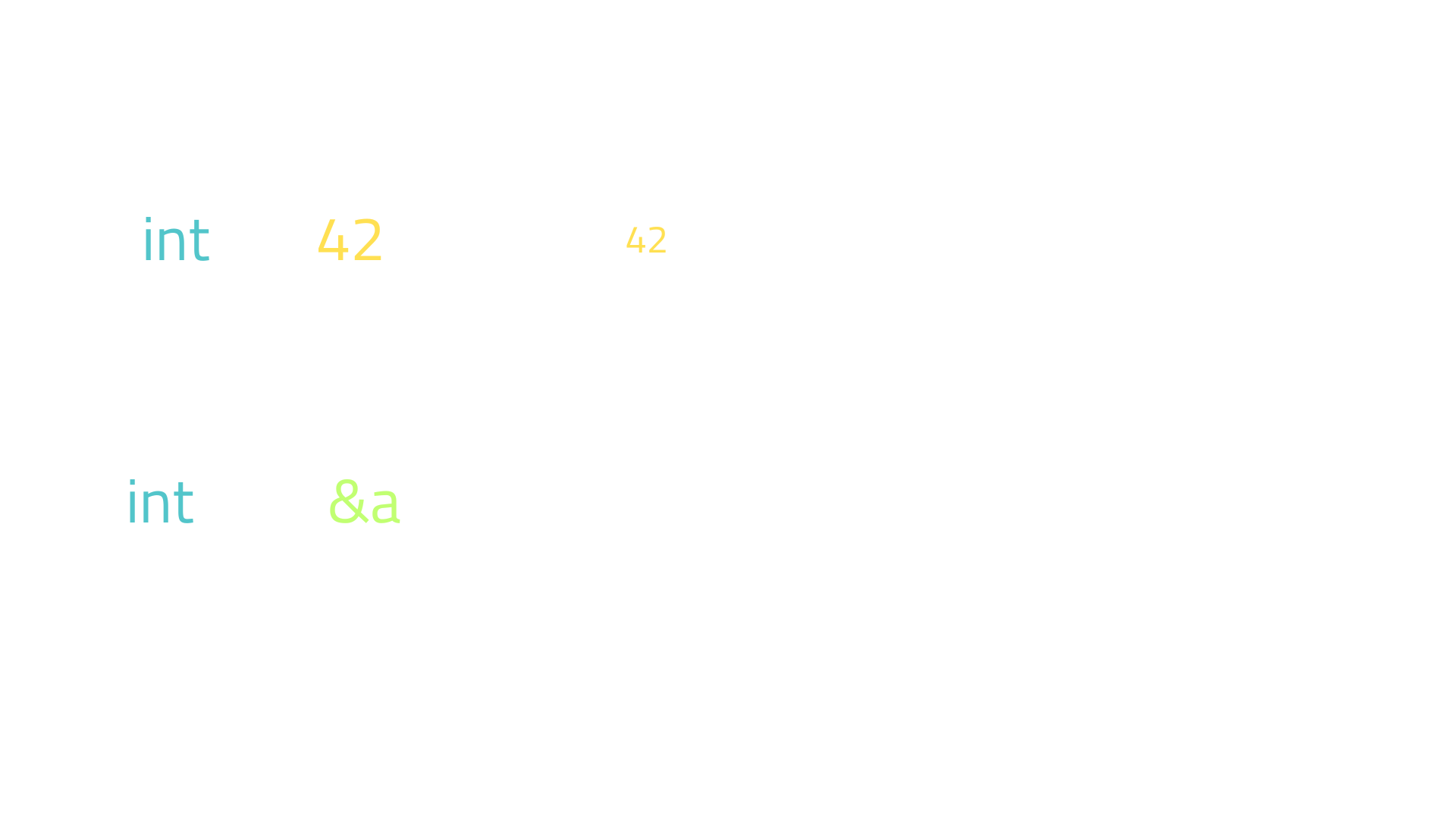
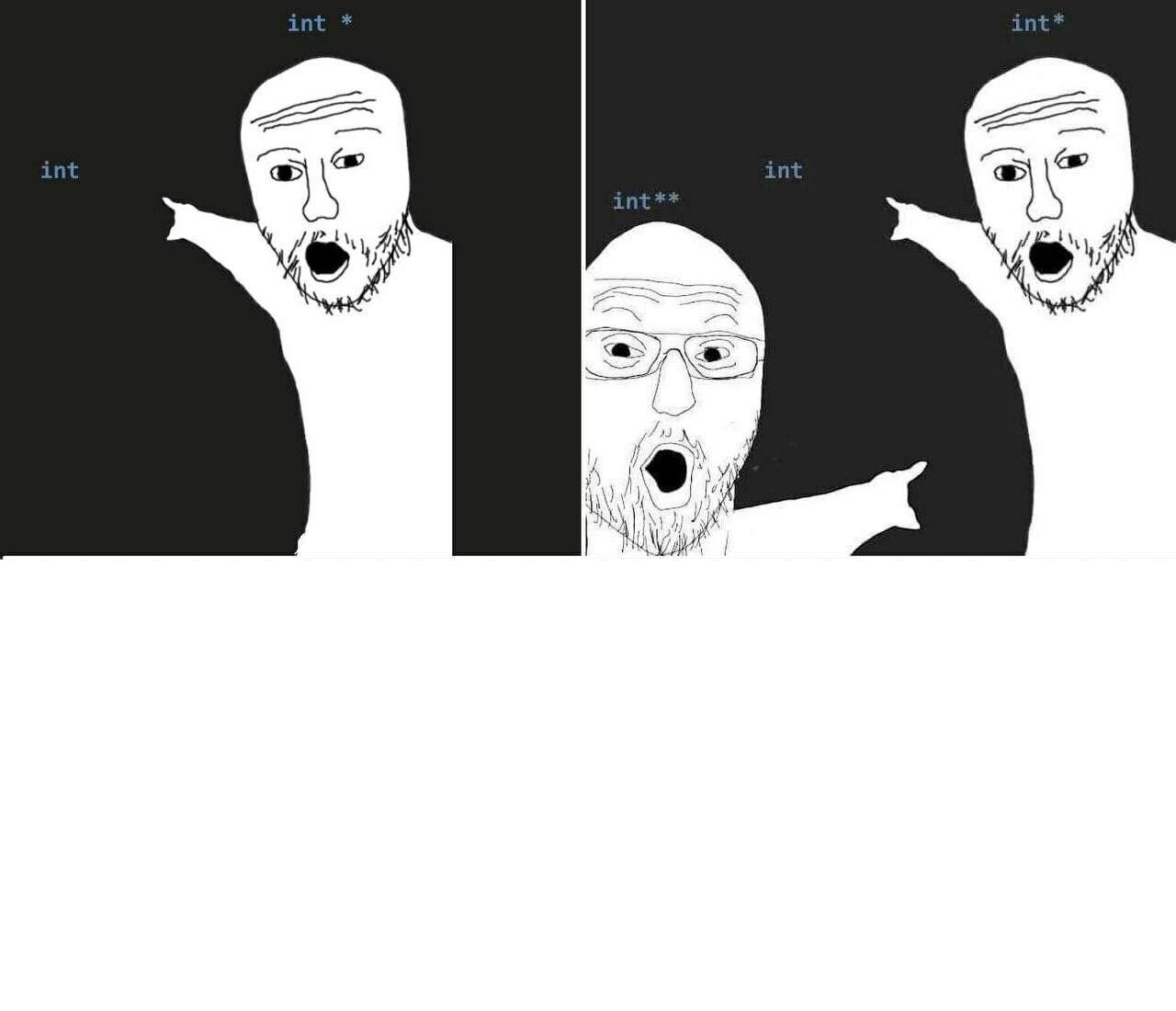
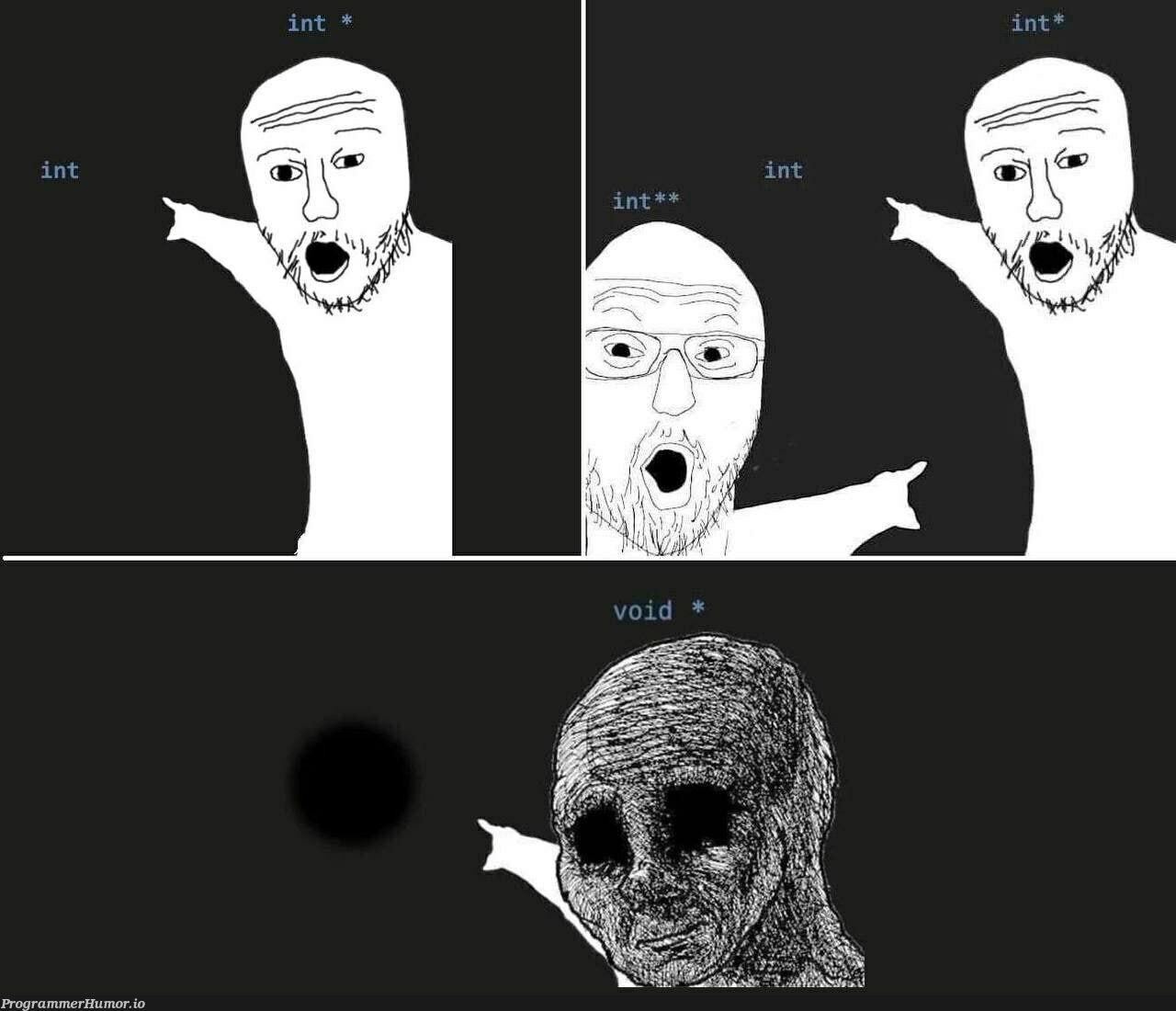
*
int *a;
C pointers (1/2)
C pointers (1/2)
The cpython repo structure
- Doc - Official documentation
- Include - Interpreter header files
- Lib - stdlib in pure Python
- Modules - stdlib in C
- Objects - built-in types
- Python - CPython runtime
PyObject (1/2)
typedef struct _object {
    _PyObject_HEAD_EXTRA
    Py_ssize_t ob_refcnt;
    struct _typeobject *ob_type;
} PyObject;
PyObject (2/2)
Using the GIL
struct _object {
    _Py_ANONYMOUS union {
#if SIZEOF_VOID_P > 4
        int64_t ob_refcnt_full; /* This field is needed
                                   for efficient initialization
                                   with Clang on ARM */
        struct {
#  if PY_BIG_ENDIAN
            uint16_t ob_flags;
            uint16_t ob_overflow;
            uint32_t ob_refcnt;
#  else
            uint32_t ob_refcnt;
            uint16_t ob_overflow;
            uint16_t ob_flags;
#  endif
        };
#else
        Py_ssize_t ob_refcnt;  // part of stable ABI; do not change
#endif
        _Py_ALIGNED_DEF(_PyObject_MIN_ALIGNMENT, char) _aligner;
    };

    PyTypeObject *ob_type;  // part of stable ABI; do not change
};
Not using the GIL
struct _object {
    // ob_tid stores the thread id (or zero). It is also used
    // by the GC and the trashcan mechanism as a linked list
    // pointer and by the GC to store the computed "gc_refs"
    // refcount.
    _Py_ALIGNED_DEF(_PyObject_MIN_ALIGNMENT, uintptr_t) ob_tid;
    uint16_t ob_flags;
    PyMutex ob_mutex;           // per-object lock
    uint8_t ob_gc_bits;         // gc-related state
    uint32_t ob_ref_local;      // local reference count
    Py_ssize_t ob_ref_shared;   // shared (atomic) reference count
    PyTypeObject *ob_type;
};
typedef struct _typeobject {
    PyObject_VAR_HEAD
    const char *tp_name; /* For printing, in format "." */
    Py_ssize_t tp_basicsize, tp_itemsize; /* For allocation */

    /* Methods to implement standard operations */

    destructor tp_dealloc;
    Py_ssize_t tp_vectorcall_offset;
    getattrfunc tp_getattr;
    setattrfunc tp_setattr;
    PyAsyncMethods *tp_as_async; /* formerly known as tp_compare (Python 2)
                                    or tp_reserved (Python 3) */
    reprfunc tp_repr;

    /* Method suites for standard classes */

    PyNumberMethods *tp_as_number;
    PySequenceMethods *tp_as_sequence;
    PyMappingMethods *tp_as_mapping;

    /* More standard operations (here for binary compatibility) */

    hashfunc tp_hash;
    ternaryfunc tp_call;
    reprfunc tp_str;
    getattrofunc tp_getattro;
    setattrofunc tp_setattro;

    /* Functions to access object as input/output buffer */
    PyBufferProcs *tp_as_buffer;

    /* Flags to define presence of optional/expanded features */
    unsigned long tp_flags;

    const char *tp_doc; /* Documentation string */

    /* Assigned meaning in release 2.0 */
    /* call function for all accessible objects */
    traverseproc tp_traverse;

    /* delete references to contained objects */
    inquiry tp_clear;

    /* Assigned meaning in release 2.1 */
    /* rich comparisons */
    richcmpfunc tp_richcompare;

    /* weak reference enabler */
    Py_ssize_t tp_weaklistoffset;

    /* Iterators */
    getiterfunc tp_iter;
    iternextfunc tp_iternext;
    /* Attribute descriptor and subclassing stuff */
    struct PyMethodDef *tp_methods;
    struct PyMemberDef *tp_members;
    struct PyGetSetDef *tp_getset;
    struct _typeobject *tp_base;
    PyObject *tp_dict;
    descrgetfunc tp_descr_get;
    descrsetfunc tp_descr_set;
    Py_ssize_t tp_dictoffset;
    initproc tp_init;
    allocfunc tp_alloc;
    newfunc tp_new;
    freefunc tp_free; /* Low-level free-memory routine */
    inquiry tp_is_gc; /* For PyObject_IS_GC */
    PyObject *tp_bases;
    PyObject *tp_mro; /* method resolution order */
    PyObject *tp_cache;
    PyObject *tp_subclasses;
    PyObject *tp_weaklist;
    destructor tp_del;

    /* Type attribute cache version tag. Added in version 2.6 */
    unsigned int tp_version_tag;

    destructor tp_finalize;
    vectorcallfunc tp_vectorcall;

    /* bpo-37250: kept for backwards compatibility in CPython 3.8 only */
    Py_DEPRECATED(3.8) int (*tp_print)(PyObject *, FILE *, int);

#ifdef COUNT_ALLOCS
    /* these must be last and never explicitly initialized */
    Py_ssize_t tp_allocs;
    Py_ssize_t tp_frees;
    Py_ssize_t tp_maxalloc;
    struct _typeobject *tp_prev;
    struct _typeobject *tp_next;
#endif
} PyTypeObject;

/* The *real* layout of a type object when allocated on the heap */
typedef struct _heaptypeobject {
    /* Note: there's a dependency on the order of these members
       in slotptr() in typeobject.c . */
    PyTypeObject ht_type;
    PyAsyncMethods as_async;
    PyNumberMethods as_number;
    PyMappingMethods as_mapping;
    PySequenceMethods as_sequence; /* as_sequence comes after as_mapping,
                                      so that the mapping wins when both
                                      the mapping and the sequence define
                                      a given operator (e.g. __getitem__).
                                      see add_operators() in typeobject.c . */
    PyBufferProcs as_buffer;
    PyObject *ht_name, *ht_slots, *ht_qualname;
    struct _dictkeysobject *ht_cached_keys;
    /* here are optional user slots, followed by the members. */
} PyHeapTypeObject;
Python C-API
Strings
docs.python.org/3/c-api/unicode.html
  char msg[] = "Hello World!";
  PyObject *s = PyUnicode_FromString(msg);
  ...
  Py_ssize_t len = PyUnicode_GetLength(s);
Lists
docs.python.org/3/c-api/list.html
  char msg[] = "Hello World!";
  PyObject *s = PyUnicode_FromString(msg);

  PyObject *l = PyList_New(0);
  PyList_Append(l, s);
  ...
Check what's the PyObject storing
  int PyUnicode_Check(PyObject *o);

  int PyList_Check(PyObject *o);

  int PyDict_Check(PyObject *o);

  int PyFloat_Check(PyObject *o);

  int PyTuple_Check(PyObject *o);
Parse arguments
  static PyObject* glob(PyObject* self, PyObject* args,
                        PyObject* kwds){

    const char *kwlist[] = {"directory", "recursive", 0};
    const char *directory = nullptr;
    int recursive = 0;

    if (!PyArg_ParseTupleAndKeywords(args, kwds,
                                     "z|p",
                                     const_cast<char **>(kwlist),
                                     &directory,
                                     &recursive)) {
      return nullptr;
    }
    ...
How does CPython works?
From Python to Machine Code
Bytecode
➡️
Specialized
Bytecode
Bytecode
➡️
Micro-Op
traces
traces
➡️
Optimized
Micro-Op
traces
Micro-Op
traces
Brandt Bucher: Building a JIT compiler for CPython (PyCon US 2024)
End of First Part Presentation
Navigating cpython
git clone https://github.com/cmaureir/cpython_tutorial
Compiler Setup
- Linux:
gcc - macOS:
clang(via XCode) - Windows:
cl(via MSVC2022)
Environment Setup
- Terminal (command-line)
- Preferable Linux or macOS
- Optional: configure your favorite IDE
Exercise 00
Compile a "Hello, World!" example in C
Exercise 01
Build cpython
Exercise 01 - Build cpython
More info: devguide.python.org/getting-started/setup-building/
For Linux/macOS
    cd cpython
    ./configure --with-pydebug
    make -j16  # or more
    ./python
For Windows
    cd cpython
    PCBuild\build.bat
    PCbuild\amd64\python_d.exe
Exercise 02
Add a Python function to cpython
Exercise 02 - New Python function in cpython
- Pick your favorite Python module (Lib/)
- Add a new function (maybe based on an existing one)
- Change parameters defaults
- Remove parameters
- Add new functionality
- Recompile (?) cpython and try it out!
Exercise 03
Add a new built-in function to cpython
Exercise 03 - New C function in cpython
- Consider functionality you know, and change it
- For example:
- pdir() like dir() but for non_dunder attributes.
Exercise 04
Add a new method to a Python container
Exercise 05
Add an alias to a Python keyword
Second Part Presentation
Extending cpython
Creating a Python C-extension
Parts of a C extension (1/4)
          static PyObject* hello(PyObject* self, PyObject* args) {
              char *msg = "Hey there!";
              return Py_BuildValue("s", msg);
          }

          static PyMethodDef the_methods[] = {
              {"hello", (PyCFunction)hello, METH_NOARGS, NULL},
              {NULL, NULL, 0, NULL}
          };
Parts of a C extension (2/4)
          static struct PyModuleDef module = {
              .m_base = PyModuleDef_HEAD_INIT,
              .m_name = "mymodule",
              .m_size = 0,
              .m_methods = the_methods,
          };
Parts of a C extension (3/4)
          PyMODINIT_FUNC PyInit_mymodule(void){
              return PyModuleDef_Init(&module);
          }
Parts of a C extension (4/4)
        >>> from mymodule import hello
        >>> hello()
        'Hey there!'
Binding generators
Python: Cython
  # hello.pyx
  def add(int i, int j):
      return i + j
  # setup.py
  from setuptools import setup
  from Cython.Build import cythonize

  setup(ext_modules=cythonize("hello.pyx"))
$ python setup.py build_ext --inplace
C++: pybind11
  #include <pybind11/pybind11.h>

  int add(int i, int j) {
      return i + j;
  }

  PYBIND11_MODULE(example, m) {
    // optional module docstring
    m.doc() = "pybind11 example plugin";
    m.def("add", &add,
      "A function that adds two numbers");
  }
  $ c++ -O3 -Wall -shared -std=c++11 \
    -fPIC $(python3 -m pybind11 --includes) example.cpp \
    -o example$(python3-config --extension-suffix)
C++: shiboken
  // test.cpp
  #include <test.hpp>

  int add(int i, int j) {
      return i + j;
  }
  // test.hpp
  int add(int i, int j);
    <!-- bindings.xml -->
    <?xml version="1.0"?>
    <typesystem package="simple">
        <function signature="add(int, int)"/>
    </typesystem>
  $ cmake -S . -B build
  $ cmake --build build
  $ cmake --install build
Zig: Ziggy Pydust
  const py = @import("pydust");

  pub fn add(args: struct { a: i32, b: i32 }) i32 {
      return args.a + args.b;
  }

  comptime {
    py.rootmodule(@This());
  }
  $ poetry install
  $ poetry run python -c "from hello_zig import hello; print(hello())"
Rust: PyO3
use pyo3::prelude::*;

/// Formats the sum of two numbers as string.
#[pyfunction]
fn hello(s: &str) -> PyResult {
    let msg = format!("Hey there {s}!");
    Ok(msg)
}

/// A Python module implemented in Rust.
#[pymodule]
fn mymodule(m: &Bound<'_, PyModule>) -> PyResult<()> {
    m.add_function(wrap_pyfunction!(hello, m)?)?;
    Ok(())
}
$ maturin develop
End of Second Part Presentation
Extending cpython
Exercise 06
Create a minimal "Hello, World!" extension in C
Exercise 07
Create a minimal "Hello, World!" extension in Zig
Exercise 08
Create a minimal "Hello, World!" extension in Rust
Exercise 09
Create a new module with one or more functions
Exercise 10
Re-write a Python functionality in Rust
Exercise 10 - Rewrite a Python functionality in Rust
- Pick any functionality you like!
- Try to keep it minimal and simple first
- For example: glob.glob
Tutorial
Understanding and expanding Python: hands-on experience with the Python internals
Dr. Cristián Maureira-Fredes
@cmaureir